
Remote Work Didn't Cause a Loneliness Crisis. It Revealed a Sensory One.
By Stephanie Warner, MSW
In response to: https://www.science.org/doi/10.1126/science.aec7671
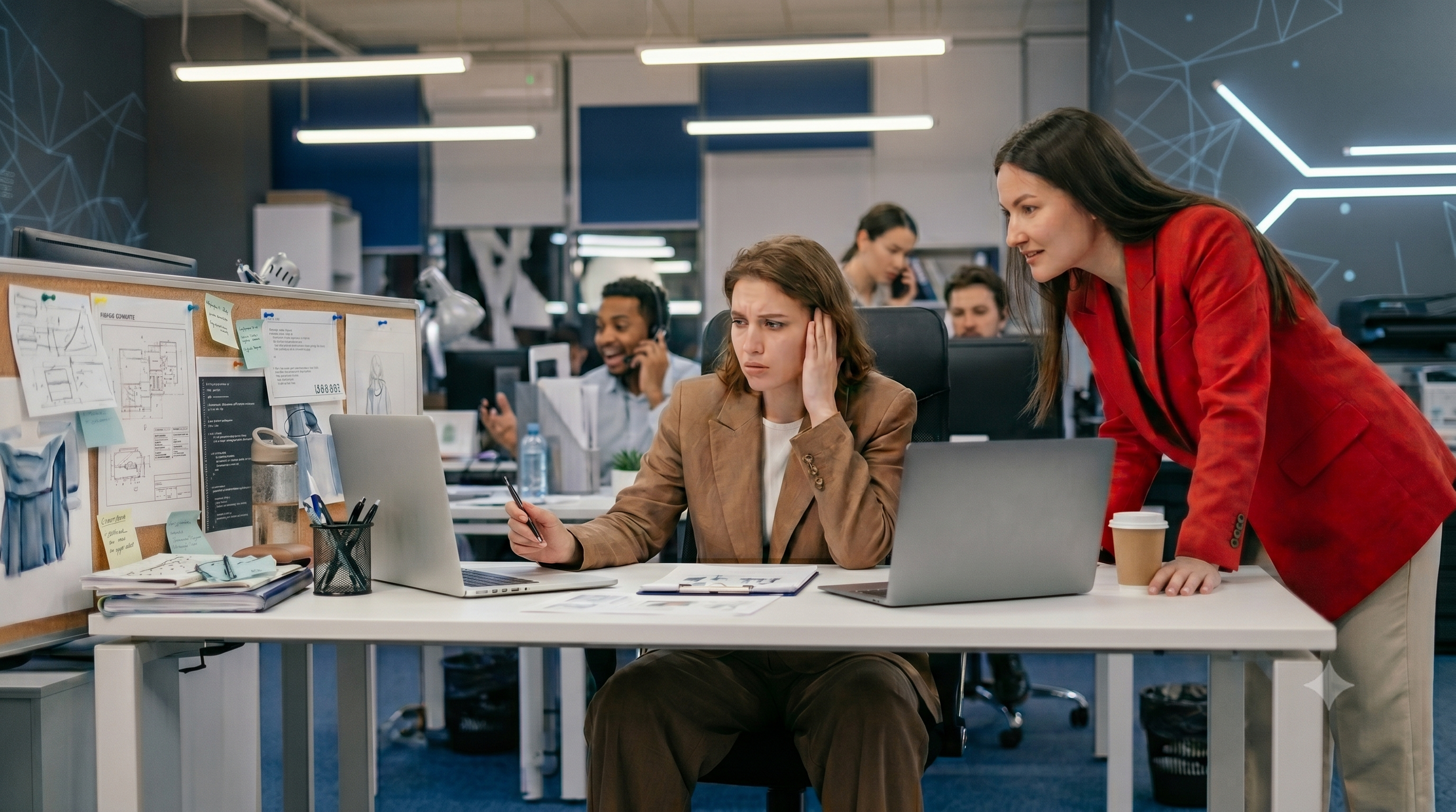
A new study in Science, by Emanuel, Harrington, and Pallais, tracked nearly 588,000 American workers and found that remote work increases mental health distress. The isolation of working from home was making people worse off. The conclusion seems obvious: bring everyone back to the office.
But the study could only measure one facet of the remote work experience. For roughly 30% of the workforce, the story is more complicated.
The office is a social environment. It is not reliably a site of connection. What the office demands of the body determines what is left for the mind.
Why the debate is headed in the wrong direction
The study's argument rests on the assumption that the office is a neutral environment and whatever was lost by going remote can be regained by returning to the office.
But for the roughly 30% of the population that is sensory sensitive, this assumption is wrong.
Offices are loud, unpredictable, and create many opportunities for someone who is sensory sensitive to become overloaded. The hum of fluorescent lights, overlapping conversations, tapping of keyboards, or someone "popping in," is not a neutral backdrop. It acts as a sensory tax that accumulates throughout the day and pulls from their capacity to think, connect, and do their work.
On the other end of the sensory continuum sits 30% of the population who are sensory seekers. The modern day work environment is more aligned with what they need to rev their engines. Remote work for this group can cause sensory deprivation that leaves them tired and unmotivated.
I know this from my career as a clinical social worker. The difference between thriving and burn out was not the work itself. It was the sensory environment I worked in.
I worked in a medical hospital and had a private office with a door. The units were mostly quiet and I could close my door between patients. The environment matched my sensory needs and I was able to do good work and maintain strong connections with colleagues.
Later I moved to an outpatient cancer center. I had a cubicle in an open office alongside schedulers who were on the phone all day. I experienced constant Wilson style greetings because I sat along the route to the restrooms. My caseload brought me all over the building with no control over who stopped me in the hallways. I burned out. Hard. Not because of the work I loved. Because of a sensory mismatch with my environment. I lost the capacity to do the "social" part of the social work because my sensory processing system was spending my capacity to get by.
What the data cannot see
Here's the problem. The study measured general distress using risk assessments designed to find what got worse, not what got better.
When a worker transitions to remote, two things happen simultaneously: social input decreases (which the researchers diagnosed as "isolation"), and sensory overload decreases (which wasn't measured). For the sensory seeking worker, less social contact and stimulation would increase their distress. But the sensory sensitive worker experiences relief under these conditions and they may return to a more regulated, optimal state. This doesn't get recorded as improvement, it's recorded as neutral. The relief is invisible. Without context or nuance, the researchers don't actually know what is being measured. The result looks like remote work uniformly harms mental health. What it actually reflects is a measurement tool that can only see in one direction.
Remote work does two things for sensory sensitive workers. It isolates them, which hurts. It also frees them from constant sensory strain, which helps. The study measured the hurt but not the help. So even if this group ended up better off overall, the data would show the opposite.
Interestingly, the negative effects in the study were much stronger for remote workers living alone. This matters because it points to something the study never set out to measure: the role of sensory environment in mental health outcomes. The researchers point out that people underestimate the impact social interactions have on their mental health. I'd argue the same is true for our sensory environments. Most people are unaware of the drain sensory input can have on our mental health, decision making, and energy.
This isn't a fringe idea. Sensory processing has been part of the conversation in pediatrics and clinical care for years. What hasn't happened yet is bringing that same understanding into the workplace, where adults spend most of their waking hours.
The framework I work from breaks this down roughly into thirds. About 30% of people are sensory sensitive, 30% are sensory seeking, and the rest fall somewhere in between. In my experience, the sensory sensitive group shows up disproportionately among people already dealing with anxiety, burnout, or other mental health struggles.
You can be surrounded by colleagues and still receive little social benefit if your sensory processing system is overloaded. That is not an engagement problem. That is an environmental mismatch outcome.
What this means for collaboration
The study assumes forced proximity creates connection. But sensory reality tells a different story.
When a sensory-sensitive worker is thrust into a high-friction office, they don't magically collaborate more. They adapt defensively. Noise-canceling headphones become armor. Optional gatherings are skipped. Common areas are avoided entirely. They're protecting their remaining capacity to actually do the work.
The deepest collaboration happens when the nervous system isn't consumed by filtering noise. Remote work isolates sensory-sensitive workers, yes. But it also returns their bandwidth to actual thinking and actual connection. The study measured one side of this equation and called it lost social infrastructure.
When leadership mandates universal return-to-office to fix an incomplete statistic, it doesn't rescue collaboration. It just transfers the cognitive tax to a different group, the 30% whose nervous systems can't afford it.
Sources:
N. Emanuel, E. Harrington, A. Pallais, "Home alone: Remote work, isolation, and mental health," Science 392 (2026). DOI: 10.1126/science.aec7671
A. Lombard, "Unlocking Mental Health and Performance: The Power of Sensory Processing in Work and Healthcare Settings," Sensory Intelligence® (2025).