My daughter Liv arrived with her own nervous system and no interest in hiding it. Everything was too itchy, too tight, too loud, too bright. She would not wear what did not work, and there was no convincing her otherwise. Her body had an opinion and she trusted it, which is the thing most adults have spent decades learning not to do. I became the person who made her world work. I found the fabric swaps, I read the care labels, I taught myself to sew so she could have clothes her body could actually live in.
It took me longer than I care to admit to notice I was doing for my daughter exactly what I had never done for myself. I was rejecting synthetic linings on her behalf while wearing a blazer I had chosen despite the fact that it hurt. What I had been missing was not self-awareness but information. Nobody had told me that how a garment looks and how it feels on your body are separate questions with separate answers. Nobody had told me that fiber content, lining science, waistband construction, and seam placement were variables I could actually choose. The other option had not been built.
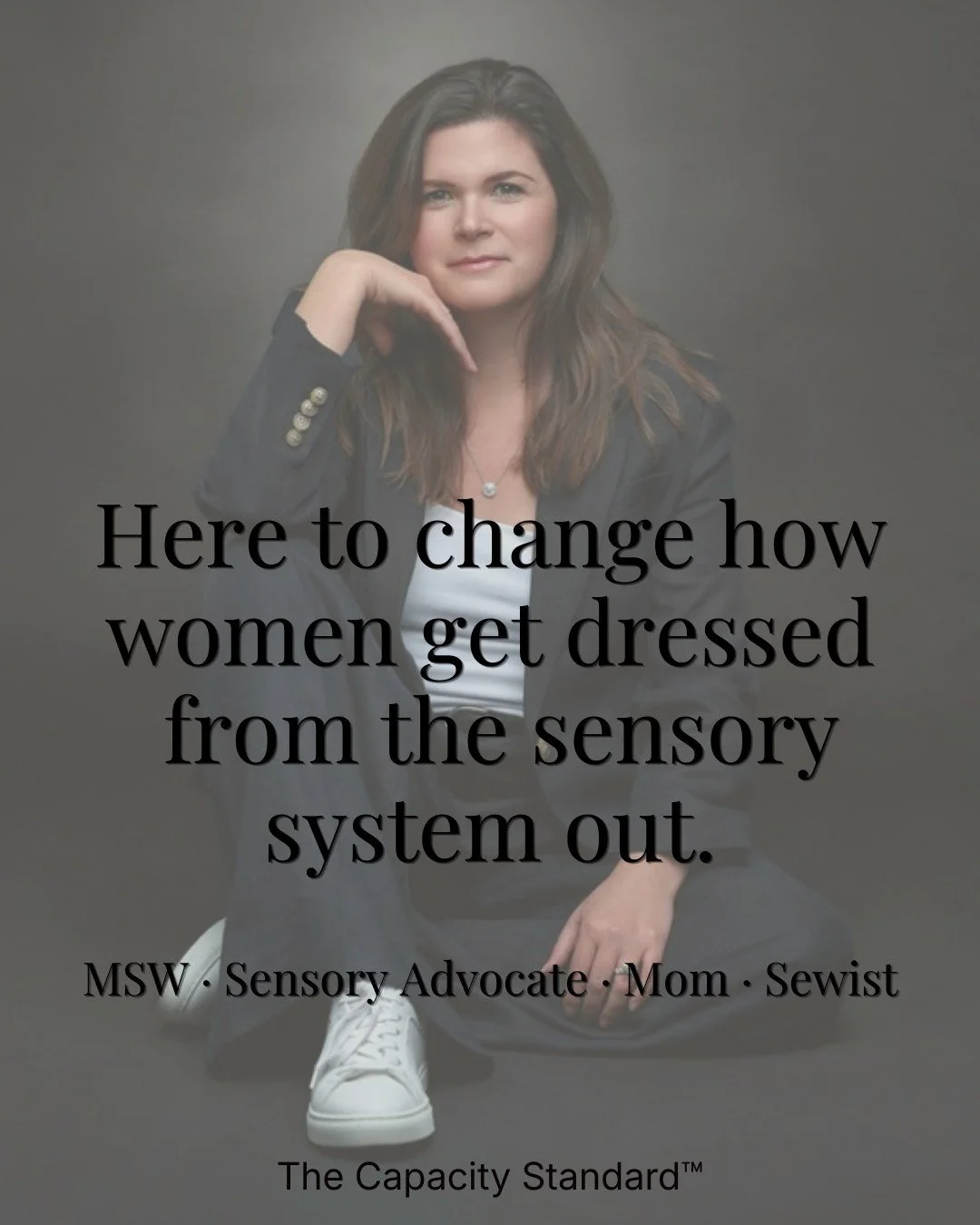
I am a clinical social worker with a Master of Social Work, degrees in psychology and leadership studies, and years of hospital-based practice. I am completing my Sensory Intelligence® Practitioner training, the same global methodology used in hospitals and corporate environments to measure sensory thresholds. I also sew, which matters because most clinicians working in sensory processing have never handled a bolt of cupro, and most garment professionals have never read the research on neurological thresholds. The Capacity Standard is the work I am building in the space between those two fields.